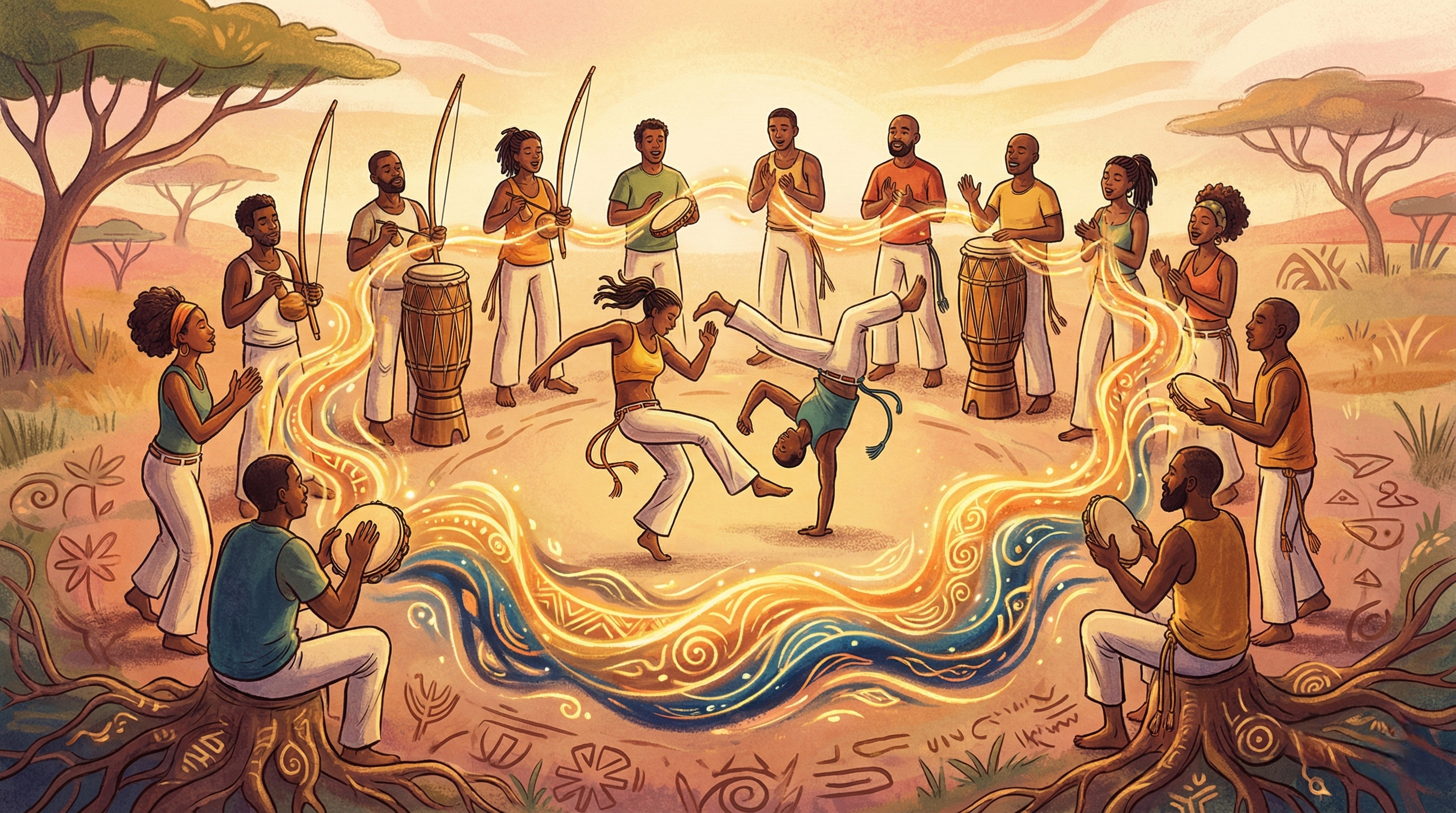
At the heart of capoeira lies a word that resists simple translation. Axê — also written as axé, aché, or rooted in the Yoruba term àṣẹ — is not merely “good energy” or a positive vibe. It is a living force that permeates the jogo, the roda, the music, and the capoeirista themselves. Originating from the Yoruba people of West Africa, axê refers to a vital power that enables existence, movement, transformation, and creation. It is the force that allows things to happen, to flow, and to come alive.
Within capoeira, when someone says “this roda has a lot of axê,” they are not commenting on atmosphere alone. They are recognizing a moment where music, movement, intention, and collective presence align, turning the roda into something more than a space for physical play. The roda becomes a living organism, and everyone inside it — musicians, players, and singers alike — becomes part of a shared current.
Axê is deeply connected to Afro-Brazilian spiritual traditions, especially Candomblé, where it represents the sacred energy transmitted by the Orixás through ritual, rhythm, song, and dance. In capoeira, this spiritual dimension remains present even when unspoken. The roda does not function as a religious ritual, yet it carries the same ancestral logic: energy is cultivated, shared, respected, and sustained through collective participation.
For the capoeirista, axê is felt before it is understood. It often appears as a shiver running down the spine when the berimbau begins to play, as a sudden emotional surge during a ladainha, or as a deep sense of connection when the jogo unfolds naturally. This sensation is not imaginary. Anatomically, intense rodas activate the nervous system, increase blood flow, elevate heart rate, and trigger the release of endorphins and dopamine. The body enters a state of heightened awareness and emotional openness, creating a feeling of clarity, presence, and unity.
Yet axê cannot be reduced to biology alone. Mestres such as Mestre Pastinha emphasized that capoeira is not just about movement, but about consciousness, respect, and inner balance. Axê emerges when intention is pure, when ego dissolves, and when the player listens — not only to the berimbau, but to their partner, the rhythm, and the moment itself.
Within the roda, axê is built collectively. It grows through sincere singing, steady rhythms, attentive clapping, and honest play. It fades when presence is lost or when the focus shifts toward domination rather than dialogue. Music plays a central role: the berimbau acts as a conductor, guiding not only tempo and style, but the emotional tone of the entire space.
Mythically, in Yoruba cosmology, àṣẹ exists in all things — humans, nature, sound, and movement. Capoeira inherited this worldview through oral tradition, allowing axê to survive not as a doctrine, but as an experience. It is the invisible thread connecting past and present, body and spirit, individual and community.
Axê is what makes capoeira more than a martial art, more than a dance, more than a game. It is the force that turns movement into meaning and presence into memory.