
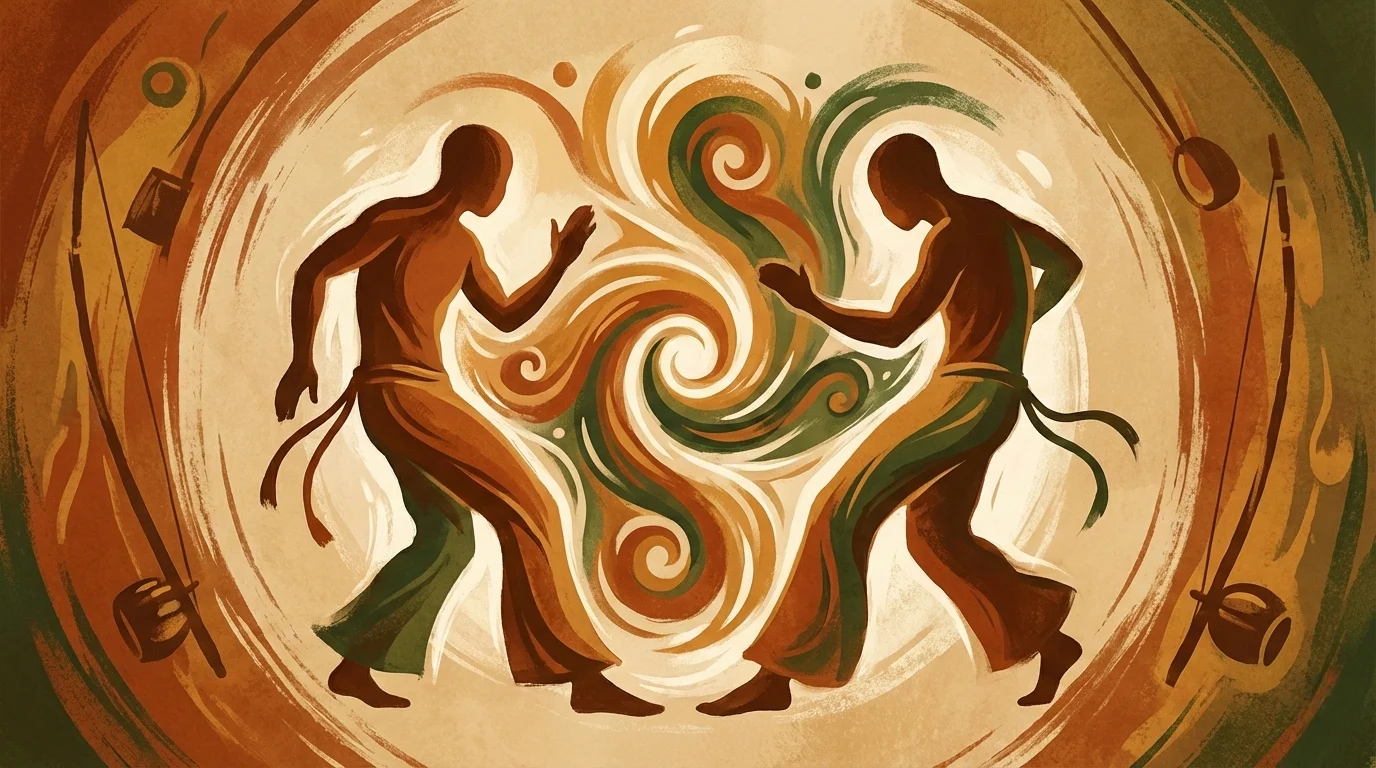
In Capoeira, the camarà is not just the person you play with. It is one of the key factors that shapes the evolution of the capoeirista as well as the entire class.
The word camarà comes from the Portuguese word camarada, which means companion, fellow traveler, someone who shares the same journey. The root of the word is connected to the idea of community, fellowship, and shared experience. In Capoeira, the word has gained a deeper meaning, as it does not merely describe a social relationship, but a living dynamic interaction within the game.
For me, the camarà has a very specific role: to provoke and create confusion. This confusion is not negative. On the contrary, it is an essential stage of learning. Through this process, the capoeirista is forced to step out of their comfort zone, adapt, think more clearly, and move more intentionally.
Capoeira is a living dialogue. It is not a predetermined choreography nor a display of moves. When the camarà knows their role, they create situations that test the perception, reflexes, and emotional balance of their partner. This is where true evolution is born.
Under pressure, there is evolution. However, pressure in Capoeira is not meant to destroy the other, but to build them. The right camarà knows when to apply pressure, when to give space, and when to guide the game towards deeper understanding.
The more consciously a camarà operates within the roda, the more the partner and the entire class evolve. An environment is created where capoeiristas learn to think, adapt, and develop personality within the game.
The Camarà as a Mirror
The camarà acts like a mirror. Through the game, character traits often not visible in daily life are revealed. Fear, impatience, ego, as well as creativity, sensitivity, and adaptability become clearly visible within the roda.
The way a capoeirista reacts to their camarà shows their level of maturity and understanding of the art. A challenging camarà may bring frustration or uncertainty. Yet, these moments are precisely the ones that create opportunities for inner growth.
In Capoeira, the camarà is not an obstacle. It is a learning tool. It is the one who reveals the gaps as well as the potential of the capoeirista. Through this relationship, the game becomes a process of self-knowledge.
The Camarà within the Class
Evolution in Capoeira is not an individual process. It is the result of a relationship. And this relationship is built through the camarà.
In a class where students understand their role as camaràs, a collective growth environment is created. Each capoeirista contributes to the evolution of the other. The level rises not because someone tries to stand out, but because everyone actively participates in the learning process.
The better a camarà knows their role, the stronger and more balanced the class becomes. A roda is created where challenge, safety, respect, and meaningful communication exist.
Capoeira is an art based on relationships. Without camarà, there is no game. And without a game, there is no evolution.