
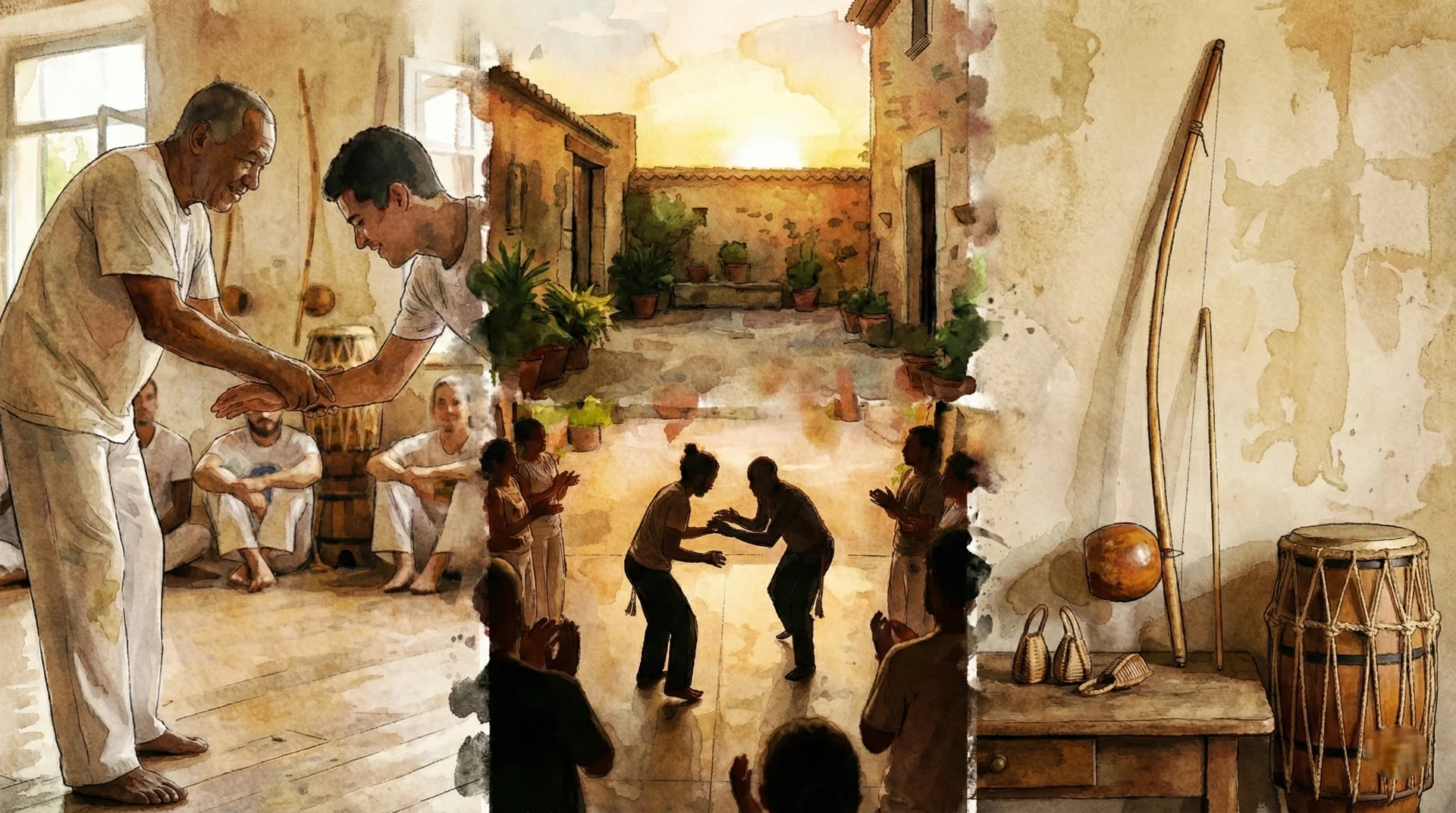
Capoeira is not merely a physical practice. It is not only movement, technique, or play. It is relationship. A relationship with oneself, with the other, and with the tradition we carry—whether we are conscious of it or not. That is why the ethics of capoeira are not an addition; they are its core.
Studying the work of Nestor Capoeira, carrying the living legacy of Mestre Bimba and Mestre Pastinha, and drawing inspiration from the path and stance of Mestre Cobra Mansa and their students, I come to understand more clearly that capoeira was born to refine power, not to display it.
Capoeira inevitably generates a sense of capability. The body becomes stronger, space opens, presence intensifies. Alongside these come self-projection, the need for recognition, and the ego. This is not wrong; it is human. The question is not whether these feelings will arise, but what we do with them.
Without guidance, capability easily turns into domination. Confidence slips into arrogance. The game loses its dialogue and becomes a monologue. At that point, capoeira appears emptied of ethics, where the other is no longer a partner but a means of self-affirmation. A capoeira that does not listen, does not wait, does not respect the time and rhythm of another body.
Mestre Bimba introduced structure not to restrict, but to protect—to teach that power requires limits. Mestre Pastinha preserved slowness to remind us that wisdom does not shout and that humility is a form of knowledge. Mestre Cobra Mansa brought us back to community again and again, because without community capoeira loses its reason for being.
When capoeira is detached from its ethics, it ceases to be an act of liberation and becomes a mechanism for reproducing power. The roda turns into a stage for display. Tradition becomes an alibi. The mestre risks becoming an unquestioned authority, and the student risks losing their voice instead of finding it. This is where toxic hierarchies are born, where concealed violence and egos dressed as “tradition” take shape.
Capoeira was never meant to intimidate. It was born to survive through intelligence, to play with danger without worshipping it, to create spaces of encounter. Its ethics are not written rules but a bodily and inner stance. They are revealed in how you enter the roda, how you look at the other, whether you make space or occupy it.
As Mestre Ligeirinho, I feel my greatest responsibility is not to show how much I know, but to keep the field clear. To remind that capoeira without ethics is merely movement. With ethics, however, it becomes a path—a path that does not promise superiority, but awareness. And that, for me, is its true power.