
Marcos Almeida Brandão (Mestre Pitbull): The Ambassador of Jacobina Who Turned Capoeira into a “Global Language”
There are people who travel to see the world, and there are people who travel to change the world, carrying their homeland in their luggage. Marcos Almeida Brandão, known to everyone as Mestre Pitbull, belongs to the second category.
Founder of Grupo Jacobina Arte, one of the most active Capoeira organizations internationally, Mestre Pitbull is not merely a martial arts teacher. He is a cultural ambassador who united two worlds: the rhythm-filled land of Bahia with Greece and the rest of Europe.
“Child of the Land” (Filho da Terra): Jacobina as Identity
In the city of Jacobina, Bahia, Marcos is not simply someone who left. Local newspapers and regional media (such as Diário da Chapada or local Bahia blogs) frequently refer to the work of Jacobina Arte with headlines filled with pride.
For the local community, Mestre Pitbull is the “Embaixador da Cultura Jacobinense” (Ambassador of Jacobina’s culture).
The Foundation in 2001
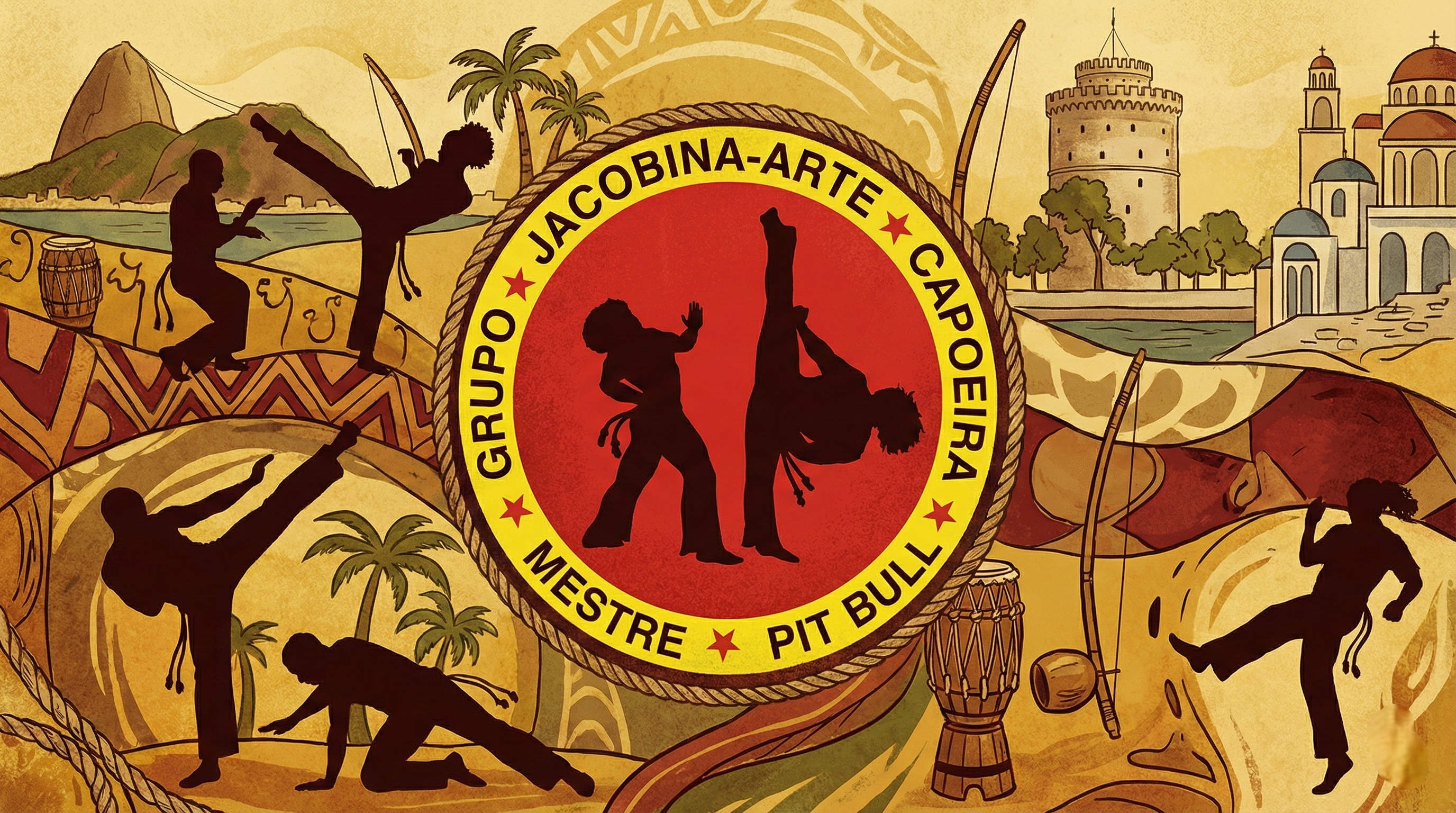
When he founded the group in Jacobina in 2001, his vision was clear: to offer young people an outlet through art and to carry the name of his city to the far corners of the world. And he succeeded. The group’s logo does not simply carry a name; it carries the identity of its origin.
Social Contribution
In Brazil, his work is recognized as a form of social service. For Pitbull, Capoeira was always a means to keep children away from the streets, offering them discipline, musical education, and a sense of family.
From Bahia to Thessaloniki: The Great Journey
His European story begins with a suitcase full of dreams and berimbaus. His arrival in Greece (Thessaloniki) around 2000–2001 was decisive. He did not find an established community; he created one.
Through his profiles and the stories of his students, the image emerges of a man who worked relentlessly. Mestre Pitbull:
Opened the Way (O Desbravador): He was among the first to teach authentic Capoeira Regional in Northern Greece, transforming curiosity into passion.
Built Bridges: He did not keep knowledge to himself. He brought dozens of Brazilian teachers to Europe, creating career opportunities for compatriots and enriching the Greek Capoeira scene with major names.
The Leader’s Profile: Beyond “Pitbull”
The nickname “Pitbull” suggests toughness and strength—qualities reflected in his jogo in the roda. Yet those who know him personally speak of a Mestre with deep empathy.
The Mentor: On his social media, one often sees posts not about himself but about the progress of his students. He celebrates the achievements of the new teachers he trained (formados, professores), from Greece to Turkey and Croatia.
The Guardian of Tradition: He insists on musicality, history, and tradition. For Mestre Pitbull, Capoeira without music and history is merely exercise.
The Legacy
Today, nearly 26 years later, the work of Marcos Almeida Brandão continues to gain recognition.
Jacobina Arte is an international family.
The city of Jacobina is heard in rodas in Athens, Thessaloniki, Paris, and Istanbul.
In the eyes of his compatriots in Bahia, he is the hero who succeeded abroad without ever forgetting where he came from. In the eyes of his students in Greece, he is the “Pai” (father) who taught them how to fall, rise, and smile in the face of life’s difficulties, guided by the rhythm of the berimbau.
“Capoeira is for everyone, but not everyone is for Capoeira. It takes heart.”— A phrase that reflects the philosophy of Mestre Pitbull.
Capoeira in Greece
The story of Jacobina Arte in Greece begins in 2000, with a meeting that would profoundly shape the course of capoeira in the country. Mestre Pitbull (Marcos Almeida Brandão), founder of Grupo Jacobina Arte in 2001 in the city of Jacobina, Brazil, was already living in France when he visited Thessaloniki as part of a large Brazilian cultural week.
At the cultural venue “Mylos” in Thessaloniki, he met his first future students in Greece, Mania Davanou and Dimos Toufexis. The timing was almost symbolic: just one day earlier, they had returned from Brazil, already deeply fascinated by capoeira through previous travels. As soon as they learned about his presence, they went to meet him, invited him to train with them in Epanomi, and later asked him to return to Greece to teach. He accepted.
Soon after, the meeting with Ligeirinho from Komotini, completed the first circle. From that moment on, the story began to unfold collectively.
The first official batizado of Jacobina Arte in Greece took place on January 26, 2002, in Thessaloniki. From then on, capoeira ceased to be an isolated practice and became a living community with continuity and identity. Jacobina Arte grew and expanded across Greece and abroad, always maintaining a strong and authentic connection to Brazil and Afro-Brazilian culture.
Mestre Pitbull opened paths for many Brazilian instructors, creating opportunities for them to travel, teach, and settle in Europe. Jacobina Arte expanded to France, Croatia, Turkey, Germany, as well as many cities in Brazil and Greece, without ever losing its core values.
The "Afro-Braz" Culture
In parallel, in 2002, a group of capoeira students in Thessaloniki began exploring the musical dimension of this culture. What started as self-taught samba-reggae rhythms on the city’s seafront evolved into the bloco Paranaue. Over time, the group became a family—not metaphorically, but in lived reality. More than twenty years of shared rhythm, experiences, and deep cultural connection.
In 2005, Mania Davanou traveled and lived in Bahia, dedicating herself to the study of Afro-Brazilian dance and tradition. Upon her return, she founded Dancaue in 2006, the first Afro-Brazilian dance school in Greece. Through movement, live music, and community, Dancaue became a natural extension of Jacobina Arte’s philosophy.
The unsung heroes of this story are not only the mestres. They are the students, the musicians, the people who opened spaces, who traveled, who believed without guarantees. Those who kept the flame alive when there were no titles or applause.
The story of Jacobina Arte in Greece is a living story of culture, relationships, and continuity. And like every true roda, it never truly ends. It continues.
Bloco Paranauê, Dançauê: https://www.dancaue.gr/