
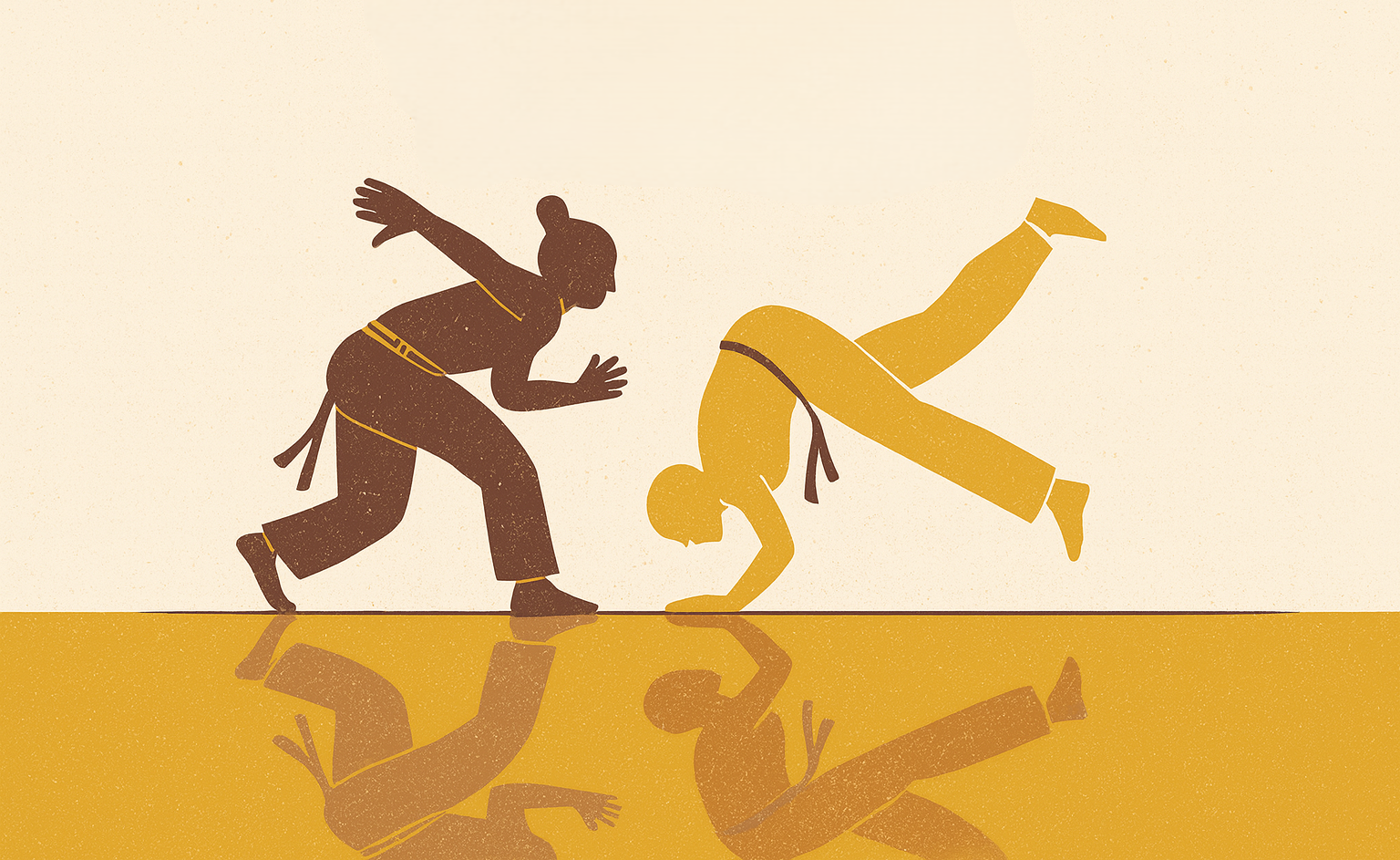
At the beginning, I didn’t really understand ginga. Not technically — that part you learn. I mean why it exists.
Why keep moving all the time? Why not just stand still for a moment? Why all this constant instability?
With time, I realised that this is exactly the point. You don’t stand still.
Ginga is not something you do. It’s how you stand.
It’s not a step. It’s not an exercise. It’s a way of being inside the game.
And if you think about it, it looks a lot like being inside a relationship. How much space you take. How much space you leave. Whether you tense up or allow yourself to move.
In ginga, if you freeze, it shows immediately. In relationships, it just takes a bit longer.
Distance
One of the first things capoeira teaches you is distance. Not too close. Not too far.
If you come in too close, you’re in danger. If you stay too far away, there is no game.
The same happens outside the roda. Some people rush in. Others never really enter.
Most of the time, both end up alone.
Control is where the game is lost
At the beginning, we all try to control things. Our body. The rhythm. The other person.
Until you realise that the more you tighten up, the less you play. Capoeira doesn’t work like that.
Neither do relationships.
Connection doesn’t come from control. It comes from presence.
We are not always in the same rhythm
There are days when ginga feels heavy. Other days it flows.
And not every day is for the same kind of game.
In relationships, we forget this. We want the other person always the same. Stable. Available.
But no one plays capoeira like that.
What stayed with me
Ginga is not there to just look good. It’s there to keep you inside.
Inside the game. Inside the relationship. Inside yourself.
To be able to come closer. To be able to move away. To not lose your rhythm just because you got scared.
If capoeira taught me one thing, it’s this: stability is not stillness. It’s the ability to stay with the movement.