
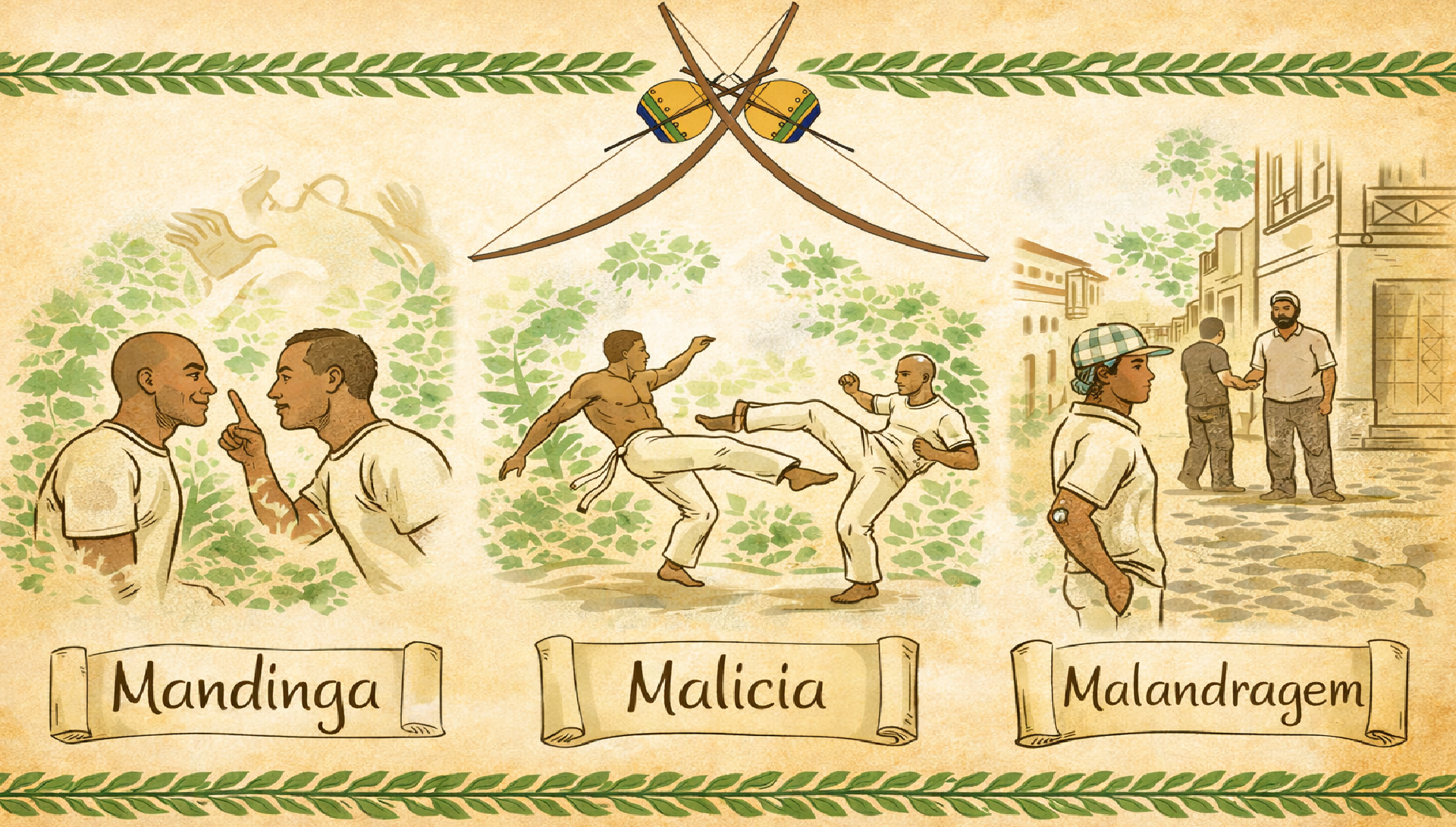
I write these words not as a teacher delivering a lesson, but as a capoeirista who is still walking the path. As infant, someone who learned to listen to the roda before speaking, to observe the body before the mind, and to respect silence as much as the song. The three “M’s” of Capoeira – Mandinga, Malícia, and Malandragem – are not concepts meant to be easily explained. They are ways of being, passed from generation to generation, from body to body, from glance to glance.
Mandinga is the most misunderstood of the three. Many confuse it with performance or something “mystical.” For me, and for the great mestres I listened to over the years, mandinga is the soul of Capoeira when it stops being mere movement. It is the moment when the body speaks without striking, when a smile becomes a question and delay becomes intention. Capoeira was never about haste. Mandinga lives in patience. It is not exhibition. It is awareness. The ability to be present without fully revealing yourself. Something deeply philosophical, close to what thinkers wrote about measure, timing, and silence.
Malícia is closer to the ground. It was born out of necessity. It was never cruelty, but intelligence for survival. The old capoeiristas did not have the luxury of directness. They had to read the environment, the opponent, society itself. Malícia is the ability to see behind the movement, to understand intention before it becomes action. It is not about tricking others, but about protecting oneself. It is the understanding that in life, as in the roda, the one who strikes first does not always win, but the one who understands first.
Then there is malandragem. The most social of the three. The most dangerous, and the most human. Malandragem carries the streets of Brazil within it: the ports, the neighborhoods, the cafés, the music, the poverty. It is the art of moving between rules without openly breaking them. It is not immorality; it is adaptability. The ability to remain standing in a world that does not want you standing. In Capoeira, malandragem is the smile that hides experience, the relaxed step that is actually precise and calculated.
These three “M’s” do not exist separately. When you truly play Capoeira, they intertwine. Mandinga gives depth, malícia sharpens perception, malandragem grants flexibility. Together, they teach something beyond the art of combat. They teach how to live without losing yourself. How to be kind without being naive. How to be strong without being violent.
If there is one thing I have learned through the years in the roda, it is that Capoeira does not ask how strong you are, but how conscious you are. And these three “M’s” are the mirror of that consciousness. They are not taught in a single training session. They are not written in rules. They are transmitted silently, when the student is ready to see—and the mestre is ready to remain silent.